Google Maps vs Organic Search: Which Wins in 2026?

Is Your Udaipur Business Ready for AI-Powered Digital Marketing in 2026?
October 10, 2026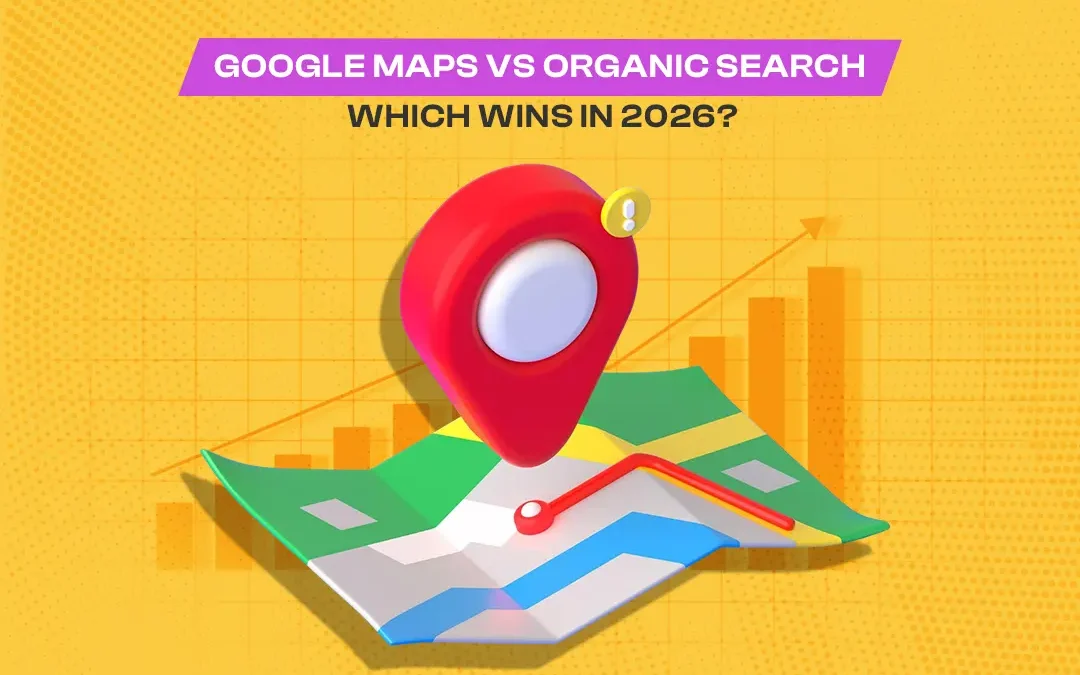
Did you ever notice that your business appears on Google Maps, but your website fails to attract leads? Or vice versa: your website ranks perfectly, but customers are still not enquiring. The question “Where should you invest in 2026?” remains unanswered.
Your business needs a strategic approach and a professional SEO Company in Udaipur to navigate growth. Let’s dig deeper and uncover major insights into the variations of Google Maps and Organic Search.
Google Maps vs Organic Search: What’s the Real Difference?
Google Maps SEO links consumers with local businesses through directions, ratings, and CTA buttons. Organic Search supports users in exploring websites, information, and services, from analysis to buying.
| Parameters | Google Maps | Organic Search |
| Primary focus | Local discovery | Broader search visibility |
| User intent | Often location-specific | Informational to transactional |
| Main conversion | Calls, directions, enquiries | Website leads, purchases, enquiries |
| Optimization focus | Business Profile & local prominence | Content, technical SEO & authority |
Why Is the Google Maps vs Organic Search Debate Different in 2026?
- AI Overviews & Zero-Click Searches: Buyers get solutions without opening a website, which improves visibility without clicks, calls, brand recall, or directions.
- Hyperlocal Search & Customer Intent: Searches such as “best local SEO near me” indicate readiness to perform. This is a valuable aspect for brands aiming for local or nearby consumers.
- AI-Powered Discovery & Organic Visibility: AI features can surface practical website content, but useful pages and credibility still decide what should appear. Here, the basics of SEO remain crucial.
Google Maps or Organic Search: Which Drives More Leads?
Google Maps are good for Local SEO services, location-dependent purchases, Calls, directions, urgent enquiries, and “Local SEO near me” searches.
On the other hand, organic search is good for comprehensive research, comparisons, broader geographical markets, and long-term content visibility.
Is ranking at the top of Google Maps important if users never become consumers? That’s why lead quality matters rather than just ranking position.
Which Offers Better ROI: Google Maps SEO or Organic SEO?
Google Maps SEO concentrates mainly on Google My Business Optimization, including correct details, citations, and reviews. Conversely, organic SEO requires sustained content, link-building, and technical support. Organic SEO results compound over time.
Competition in both aspects depends on the area’s population and niche-based industries. Alongside this, results can be measured by tracking enquiries, conversions, and acquisition costs, not rankings alone.
A local restaurant receives walk-ins and bookings through Maps, but B2B services rely on organic content users read during search.
Google Maps vs Organic Search: What & Where Businesses Should Invest in 2026?
This section is the highlight of this blog, responding to the key question: “Where should you invest in 2026?” Let’s read further:
Local retail & hospitality
Prioritize Google Maps to captivate local consumers while upholding and optimizing web enquiries, bookings, and service details.
Professional service providers
Handle Google Maps visibility with organic SEO to produce local enquiries and enhance rankings for services.
E-commerce
Concentrate on organic search to enhance product visibility and sales, incorporating Google Maps when physical stores are available.
B2B
Organic SEO is crucial and has been upgraded through AI-optimized search. It’s helpful for reaching potential consumers looking for industry solutions while managing accurate business details on Google Maps.
The right medium depends on where your consumers search and how they respond.
Conclusion
Google Maps gains ground through reliable local search engine optimisation and high-intent discovery. Organic search gets spotlight through research, authority, and reach.
SEO should be chosen according to consumer preferences, marketing objectives, and conversion opportunities. Finding the right local SEO agency supports businesses in choosing the right type of SEO for assured results.
For instance, Urban Media, a well-known SEO Company in Udaipur, brings innovative, trend-focused, and result-oriented digital marketing services near you. Want to turn search visibility into business queries? Explore actionable GMB SEO strategies with us now!
FAQs
Can a business rank on Google Maps without a website?
Yes. A well-structured Google Business Profile can reflect in Maps results without a website. A website still gives credibility and supports organic rankings.
Can Google Maps & Organic SEO Work Better Together?
Yes. Maps indicate local, ready-to-act buyers, whereas organic content establishes trust and reach. Consistent details and credible reviews strengthen both.